
CHEKHOVEK 2026
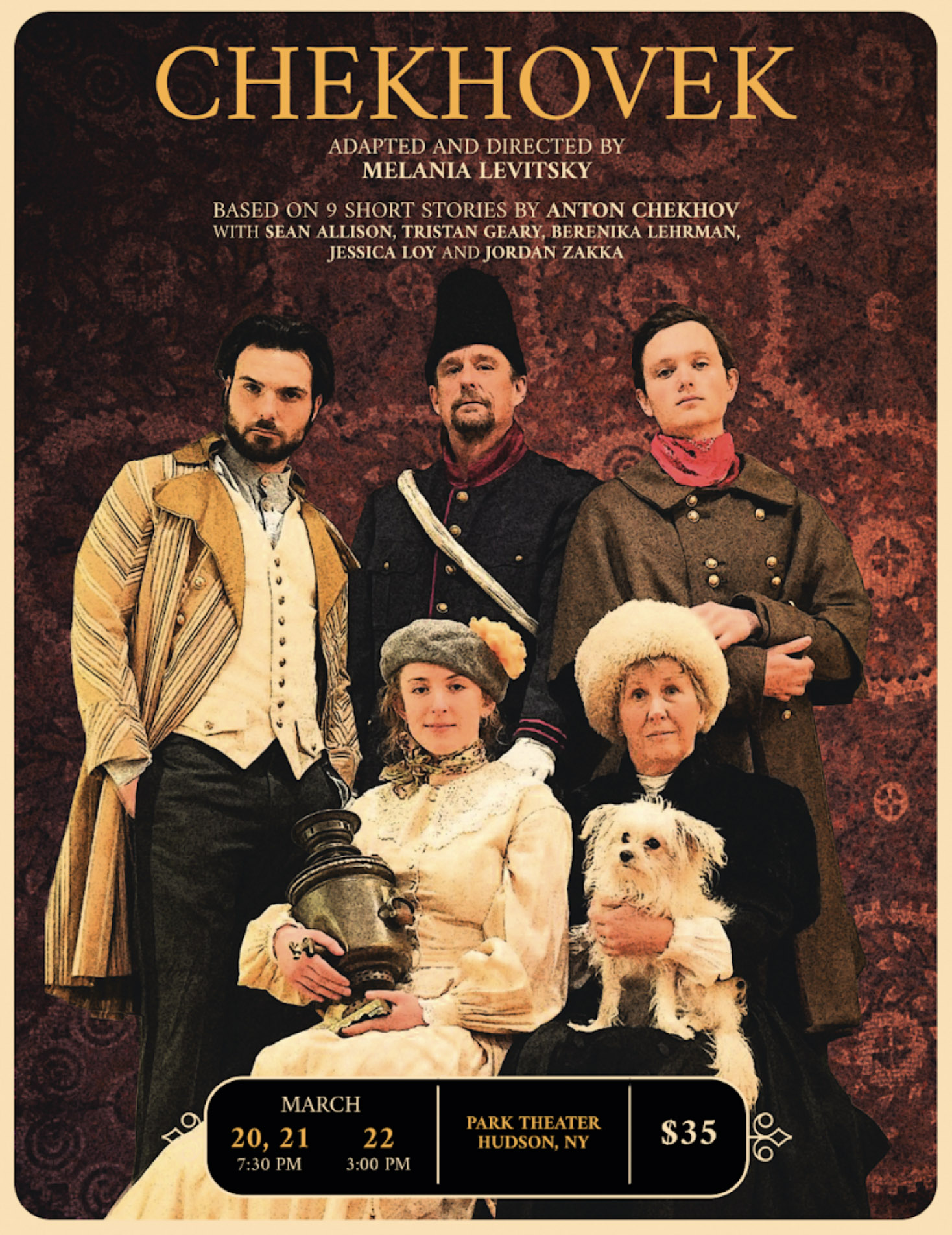
March 2026, NY and MA: CHEKHOVEK 2026
Chekhovek began when I saw a group of actors in Michael Howard’s Tuesday master class in NYC, doing scenes from some short stories by Anton Chekhov, sometime in 2008.
I read several dozen stories and was inspired to adapt a full-length play.
The play was originally titled VIRTUE DESIRE DEATH and FOOLISHNESS. It had a four-week run in Hudson, NY and then got picked up by some enthusiastic backers and moved to an Off-Broadway theater in Manhattan.
In 2026, after shooting a short film called STAGE LEFT about the backstage life during a run of CHEKHOVEK, I decided to restage it with a new cast and some script edits.
We had a sold-out three-week tour in NY and MA in March 2026.
CHEKHOVEK*
(*Chekhovek /ˈtɕεxəfˈıek/ n. [Russian; derived from chelovek, meaning person; vek, meaning century, or life (arch.); and Anton Pavlovich Chekhov, author, 1860-1904.] A comedy about desire, death and foolishness, in 14 scenes.)
Chekhovek is a COMEDY, adapted from 9 short stories by Anton Chekhov, with a multitude of characters, acted by a cast of five. Adapted and directed by Melania Levitsky.
Filled with the compassion and humor of an observer who is both doctor and journalist, critic and poet, Chekhov’s stories bear witness to the spectacle of ordinary people in conflict with their ordinary fantasies and failures.
The Lady with the Dog
Death of a Government Clerk
The Ninny
A Blunder
A Chorus Girl
The Chemist’s Wife
The Black Monk
The Huntsman
Vanka
With Sean Allison, Tristan Geary, Berenika Lehrman, Jessica Loy, and Jordan Zakka.
Laura Geilen on Accordion, Jonathan Talbott on Violin
Shakespeare’s Supernaturals

July 14-17, 2016: Hawthorne Valley: Shakespeare’s Supernaturals
To the original audience of Macbeth, Midsummer Night’s Dream, The Tempest and Hamlet, life was understood by the existence and influence of ghosts, witches, devils, faeries and nature spirits. In the 16th and 17th centuries the Elizabethans believed heartily in the chain of being, consisting of 27 levels of devils, angels and plant, animal and nature deities. It was believed that a king was ordained by God and angels to sit upon his throne. His advisors were of the celestial realm and his position was insured by heaven.
William Shakespeare and his contemporaries were obsessed with the human relationship to the heavenly, spiritual chain of being: will the angels help them? can humans rise above their station? how does one deal with possession and/or exorcism? will the devils aid in exacting revenge? can kings and queens attain immortality?
Our tale begins with a “scientific” refusal by Theseus to believe in anything but the physical: the eternal world is of the imagination and therefore does not exist. By contrast, the secret of Hamlet’s destiny is revealed by the spirit of his deceased father. Truth and justice are unleashed by the tortured ghost of a murdered king searching for revenge. Mercutio steps in to expound on Queen Mab, “the Faerie’s midwife” who influences us through our dreams.
When Macbeth first meets the witches he is skeptical, until their prophecy of becoming Thane of Cawdor is immediately fulfilled. Impatient and hungry for power, Macbeth then takes this prophecy into his own hands, he kills to become king. Lady Macbeth, consumed with a furious lust for power, engineers her own demonic possession. The Macbeths’ immense arrogance in rejecting the wisdom of the witches results in their own destruction.
Another glimpse of the overzealous human lust for power is seen in the sorcerer/magician Prospero. He practices his wizardry by enslaving beings of the spiritual world and using them to exact revenge. When Ariel teaches Prospero compassion, he renounces his wizardry and becomes content to be merely human.
Lastly, we invite you into the Faerie realm where King Oberon inflicts punishment upon Queen Titania through a love spell. Oberon and Puck, his jester, delight in the love affair between Titania and the mortal Bottom the Weaver, whom Puck has transformed into an ass, or “monster”. Bottom shows us (unlike Macbeth) that by allowing the spirit world to unfold to us, great heights of love and imagination are possible.
James Luce
The Winter’s Tale
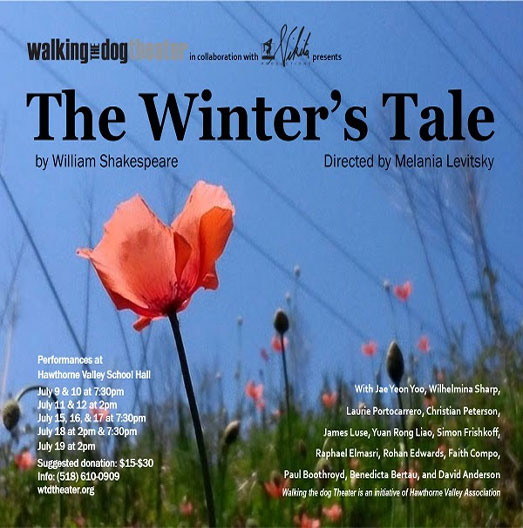
July 9 – 19, 2015, Hawthorne Valley:
The Winter’s Tale
Walking the dog Theater collaborates with NIKITA Productions to present William Shakespeare’s The Winter’s Tale at the Hawthorne Valley School Hall in Ghent this July 9-19.
Director Melania Levitsky describes the play as a venture “from prosperity, through destruction, to regeneration and renewal.” With Jae Yeon Yoo, Wilhelmina Sharp, Laurie Portocarrero, Christian Peterson, James Luse, Yuan Rong Liao, Simon Frishkoff, Raphael Elmasri, Rohan Edwards, Faith Compo, Paul Boothroyd, Benedicta Bertau, and David Anderson.
Self Made Man: the Frederick Douglass Story
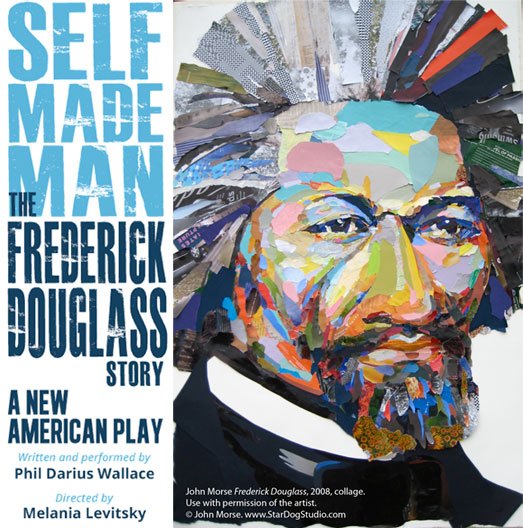
July 9 – 19, 2016, NYC:
Self-Made Man: the Frederick Douglass Story
SELF MADE MAN: THE FREDERICK DOUGLASS STORY takes the audience on a journey of the American legend who became the father of our nation’s civil rights movement. Phil Darius Wallace portrays 14 different characters who influenced Douglass’ life, reconstructing the complexity and radiance of Douglass’ spirit on his path from deprivation to greatness. Read more.
Created by and Starring:
Phil Darius Wallace
Melania Levitsky, Director
Derek Yip, Producer